


Creatine Is an Energy Buffer — Not Just a Muscle Supplement.
Creatine is best known for strength and high-intensity exercise, but the phosphocreatine system also exists in the brain. Research is now examining whether supporting that energy-buffering system can help cognition — particularly when the brain is stressed by sleep deprivation, aging, or limited creatine availability.
Creatine has spent decades being marketed as a gym supplement.
That made sense.
Skeletal muscle stores large amounts of creatine and phosphocreatine, and the performance evidence is deep.
But skeletal muscle does not own the creatine system.
The brain uses ATP constantly.
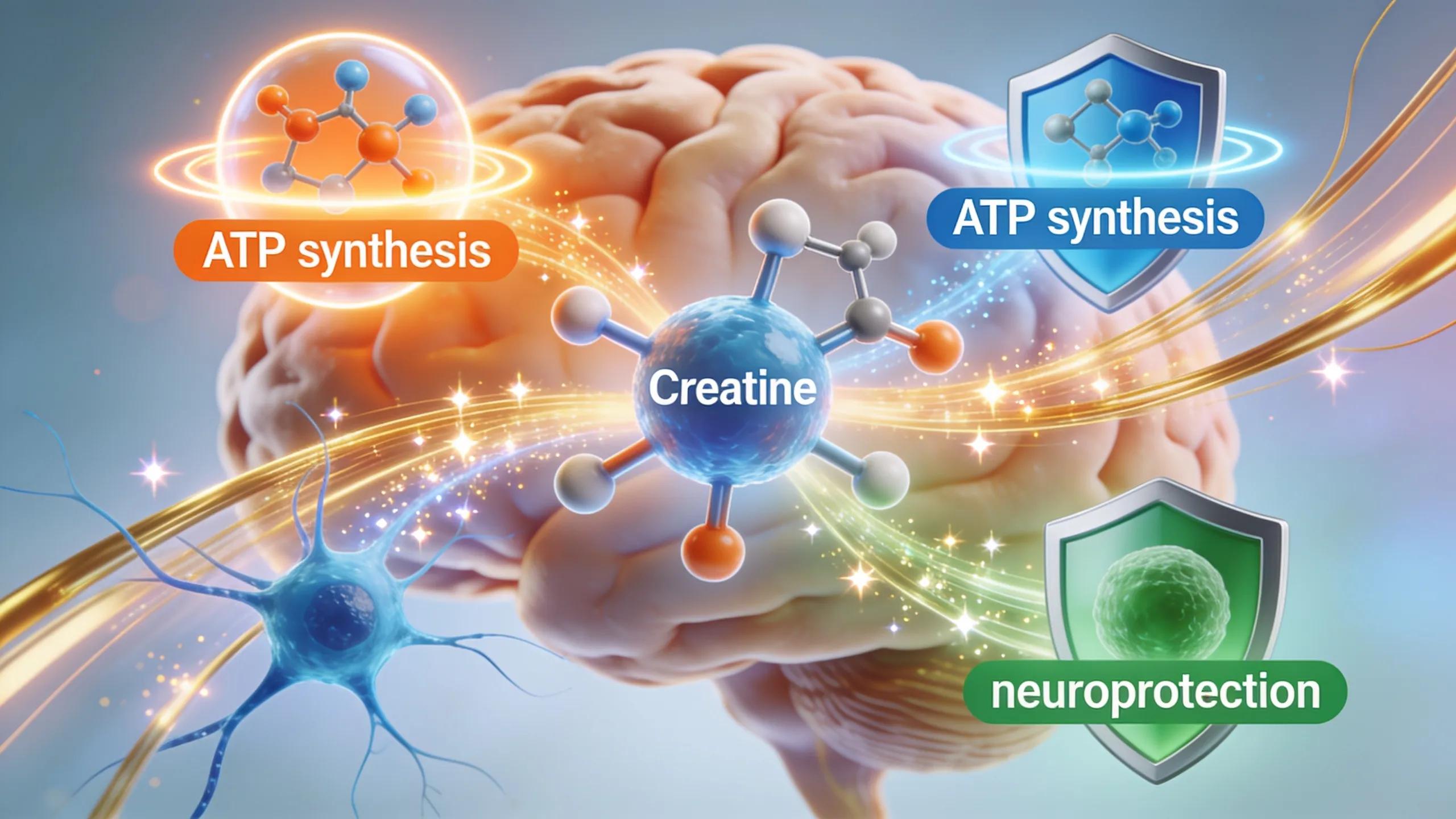
It also contains creatine kinase and phosphocreatine systems that help buffer fluctuations in cellular energy demand.
What Does Creatine Actually Do in the Brain?
ATP is the immediate energy currency used by cells.
Phosphocreatine can donate a phosphate group to ADP to help regenerate ATP during periods of increased energy demand.
This creatine–phosphocreatine system acts as an energy buffer.
In the brain, that is relevant to processes including:
- neuronal signaling
- maintenance of ion gradients
- synaptic activity
- cellular energy homeostasis
Creatine Can Increase Brain Creatine — But the Brain Is Harder to Load Than Muscle.
Human research supports the ability of supplementation to influence brain creatine concentrations, but the response is smaller and less predictable than skeletal-muscle creatine loading. The blood-brain barrier is part of why translating muscle dosing directly into brain outcomes is not straightforward.
Does Creatine Improve Memory and Cognition?
Maybe — but not across every cognitive domain and not in every population.
A 2024 systematic review and meta-analysis found statistically significant improvements in:
- memory
- attention time
- processing-speed time
But it did not find a significant improvement in:
- overall cognitive function
- executive function
“Cognitive Benefit” Is Too Broad a Claim.
Memory, attention, processing speed, executive function, reaction time, and mood are different outcomes. A benefit in one domain should not be rewritten as “creatine makes you smarter.”
Other systematic reviews remain more cautious.
A separate 2024 review concluded that creatine can increase brain creatine content but found cognitive outcomes overall to be equivocal, with the strongest reason for further study appearing in metabolically stressed populations.
The Strongest Brain Signal May Appear When Energy Demand Is High.
Creatine may be more useful cognitively when the brain is under metabolic stress — such as sleep deprivation — than when a healthy, well-rested person is already functioning normally.
Sleep Deprivation Is Where the Story Gets Really Interesting.
Sleep loss creates a metabolic problem as well as a fatigue problem.
During extended wakefulness, the brain has to sustain cognitive function under increased energetic stress.
That makes phosphocreatine buffering biologically interesting.
What Did the 2024 Sleep-Deprivation Study Find?
Researchers tested creatine during approximately 21 hours of sleep deprivation.
Participants received a single large dose of creatine monohydrate:
0.35 g per kilogram of body weight.
The investigators found changes in cerebral high-energy phosphate measures along with improvements in cognitive performance and processing speed compared with placebo.
⚠ This Was NOT a Normal 5-Gram Creatine Dose.
For a 180-pound adult, 0.35 g/kg would equal roughly 29 grams of creatine in one experimental dose. That study should not be converted into a recommendation to take 20–30 grams whenever you miss sleep.
And the 2026 Follow-Up?
A 2026 study tested a smaller acute dose:
0.2 g/kg.
Creatine was associated with reduced deterioration in several cognitive tasks during sleep deprivation, including logical and numerical performance, processing speed, and psychomotor vigilance.
The investigators reported effects smaller than those seen with the higher 0.35 g/kg dose.
Creatine May Help the Brain Handle an Energy Problem. It Does Not Replace the Sleep That Created the Problem.
Protecting cognitive performance during an experimentally sleep-deprived day is not the same as repairing sleep debt, restoring hormonal rhythms, improving cardiovascular recovery, or replacing adequate sleep.
Does Creatine Improve Sleep Quality?
That claim is much less established.
Research showing improved cognition during sleep deprivation does not mean creatine makes sleep deeper, longer, or more restorative.
Those are completely different endpoints.
Cognitive Resilience After Poor Sleep ≠ Better Sleep.
Creatine should not be positioned as a sleep supplement simply because it may partially buffer cognitive deterioration during sleep deprivation.
Why Vital Forge Uses Creatine Monohydrate
The cognition studies use the same form that dominates the exercise literature:
creatine monohydrate.
We do not need a “brain creatine” proprietary form to make the ingredient interesting.
5 g Creatine Monohydrate. One Simple Daily Tool.
Vital Forge provides 5 grams of creatine monohydrate per serving for adults who want the most extensively studied creatine form in a straightforward daily powder.
The 5-gram serving is aligned with common maintenance use in performance and healthy-aging contexts. It should not be represented as equivalent to the very high acute experimental doses used in sleep-deprivation research.
Explore Vital Forge →What Is a Normal Daily Creatine Dose?
For muscle creatine saturation and general maintenance, a commonly studied approach is:
3–5 grams of creatine monohydrate daily.
Loading is optional.
A loading phase of roughly 20 grams per day divided across several doses can saturate skeletal muscle faster, but consistent lower daily dosing reaches saturation more gradually.
There Is No Established Universal “Brain Dose.”
Cognitive studies have used widely different dosing strategies. The high acute doses used during sleep-deprivation experiments should not be assumed to be necessary, optimal, or appropriate for routine cognitive supplementation.
What About Creatine and Healthy Aging?
This is where creatine may have its most compelling non-athlete story.
Aging challenges several systems at once:
- muscle mass
- strength
- physical function
- energy metabolism
- cognitive performance
Creatine research spans several of those areas.
What Does the 2026 Older-Adult Cognition Review Show?
A 2026 systematic review examined creatine and cognition specifically in adults age 55 and older.
Only six studies met inclusion criteria.
Five reported some positive relationship between creatine and cognition, particularly memory and attention.
But the review also found important limitations:
- only two studies were double-blind supplementation trials
- several studies were observational
- methodological quality ranged from good to poor
Promising for Healthy Aging. Not a Dementia Treatment.
The current evidence supports continued research into creatine and cognition in older adults. It does not justify claiming creatine prevents Alzheimer’s disease, reverses cognitive decline, or functions as a dementia therapy.
The Healthy-Aging Case Is Bigger Than the Brain.
Maintaining muscle and strength is itself a major healthy-aging goal.
Creatine combined with resistance training has a much stronger evidence base for supporting strength and lean-mass-related outcomes than creatine alone does for most cognitive endpoints.
Creatine Does Not Replace Protein.
Creatine supports phosphocreatine availability and training capacity. Protein supplies the essential amino acids required to maintain and rebuild tissue.
Read Protein for Healthy Aging →If Protein Intake Is the Bottleneck, Fix the Protein.
Vital Iso
Complete whey isolate for adults who want efficient delivery of essential amino acids.
Vital Pure
Complete whey protein when the goal is simply getting more quality protein into the day.
Vital Root
Dairy-free protein for adults who prefer or require a plant-based route.
Does Creatine Increase Longevity?
We do not know.
There is currently no convincing evidence that creatine supplementation extends human lifespan.
That does not make creatine irrelevant to healthy aging.
Longevity is not only about how long someone lives.
It is also about preserving:
- strength
- muscle
- mobility
- independence
- possibly aspects of cognitive function
Healthspan Evidence Is Not Lifespan Evidence.
Supporting strength, training capacity, or selected cognitive outcomes can contribute to a healthy-aging strategy. That is very different from claiming creatine slows biological aging or makes people live longer.
Vital Forge or Performance Pack?
Different goal. Different tool.
Vital Forge
5 g creatine monohydrate when creatine itself is the defined goal.
Explore Vital Forge →Performance Pack
Creatine plus BCAAs, carnitine, NR, cordyceps, and rhodiola when multiple performance pathways are the goal.
Explore Performance Pack →Do You Need a “Brain Stack” With Creatine?
Not automatically.
One of the easiest mistakes in wellness is taking an interesting ingredient and immediately surrounding it with five more.
If the goal is creatine:
creatine may be enough.
Don't Turn One Interesting Brain Study Into a Nootropic Shopping List.
Sleep, exercise, blood pressure, glucose control, hearing, social engagement, nutrition, and treatment of medical conditions all matter to cognitive aging. Creatine should sit inside that framework rather than replace it.
When Does Creatine Make the Most Sense?
Strong reason to consider creatine.
Creatine can fit especially well alongside resistance training and adequate protein.
Reasonable area of interest, but expectations should stay modest because results remain mixed.
Fix the sleep problem. Creatine is not a sleep-debt payment plan.
Human lifespan extension has not been demonstrated.
Is Daily Creatine Safe?
Creatine monohydrate has a substantial safety literature in generally healthy adults.
It can modestly increase serum creatinine because creatinine is related to creatine metabolism.
That does not automatically mean kidney function has worsened.
Tell the Clinician You Use Creatine When Kidney Labs Are Being Interpreted.
Creatine supplementation is relevant context when interpreting serum creatinine and creatinine-based estimated kidney filtration.
Individual guidance is more important for people with:
- known kidney disease
- significant medical complexity
- pregnancy or breastfeeding
- fluid-management disorders
- complex medication regimens
Use Creatine Because It Has a Job — Not Because “Longevity” Sounds Good on a Label.
Training capacity. Healthy-aging muscle support. Possibly selected cognitive outcomes. Those are defensible conversations. Sleep replacement, dementia prevention, and lifespan extension are not.
Frequently Asked Questions
Does creatine help memory?
Some controlled trials and meta-analyses suggest modest improvements in memory, while other cognitive outcomes remain inconsistent. Benefits may depend on population, baseline creatine status, diet, age, and metabolic stress.
Does creatine make you smarter?
That is too broad. Research suggests possible benefits in selected cognitive domains, but creatine has not been shown to universally improve overall cognition or intelligence.
Does creatine help when sleep deprived?
Experimental studies suggest that high acute doses of creatine can partially reduce deterioration in selected cognitive tasks during sleep deprivation. Those studies used much larger doses than standard daily maintenance supplementation.
Does creatine improve sleep?
That is not established. Improving cognitive resilience during sleep deprivation is not the same as improving sleep quality, sleep duration, or recovery from chronic sleep debt.
Should I take 20–30 grams of creatine when I miss sleep?
No routine recommendation can be made from the experimental sleep-deprivation trials. Their large single doses were used under controlled research conditions and should not be copied as a self-treatment protocol.
Does creatine prevent dementia?
No evidence currently establishes creatine as a treatment or preventive therapy for dementia. Cognitive research in older adults is promising but still limited.
Does creatine increase lifespan?
Human lifespan extension has not been demonstrated. Creatine may support elements of healthspan — particularly muscle strength and function — without proving a direct longevity effect.
What form of creatine has the most evidence?
Creatine monohydrate remains the most extensively researched form across sports performance, healthy aging, and cognition research.
How much creatine is in Vital Forge?
Vital Forge provides 5 grams of creatine monohydrate per serving.
Do I need to cycle creatine?
Routine cycling is not required. Consistent daily use is the more common maintenance approach.
Key Evidence
2024 systematic review and meta-analysis.
Creatine supplementation was associated with improvements in memory, attention time, and processing-speed time, while overall cognition and executive function did not significantly improve.
PubMed →
2024 sleep-deprivation trial.
A single 0.35 g/kg creatine dose during approximately 21 hours of sleep deprivation altered cerebral high-energy-phosphate measures and improved selected cognitive outcomes.
PubMed →
2026 sleep-deprivation study.
A lower 0.2 g/kg acute creatine dose was associated with reduced deterioration in selected cognitive and psychomotor tasks during sleep deprivation.
PubMed →
2026 systematic review in older adults.
Limited evidence suggests possible benefits for cognition, particularly memory and attention, but higher-quality clinical trials are still needed.
PubMed →
Support the Energy System. Don't Invent the Outcome.
Creatine participates in brain-energy buffering. Cognitive research is promising. Sleep-deprivation data are fascinating. Healthy-aging applications deserve continued attention. None of that makes creatine a substitute for sleep, a dementia treatment, or a proven longevity drug.
The Takeaway
The brain uses creatine and phosphocreatine to help buffer cellular energy.
Creatine supplementation may improve selected cognitive outcomes, but overall results remain mixed.
Benefits may be more apparent during metabolic stress such as sleep deprivation.
The sleep-deprivation trials used much larger acute doses than routine 3–5 g/day maintenance intake.
Creatine has not been shown to replace sleep.
It has not been shown to prevent dementia.
It has not been shown to extend human lifespan.
Its healthy-aging case is currently stronger when muscle, strength, physical function, and resistance training are included in the conversation.
Creatine monohydrate remains the most extensively studied form.
Support the energy system. Respect the evidence level. Keep sleep, muscle, and healthy aging in the same conversation.
This article is for educational purposes only and is not medical advice. Creatine needs and suitability vary with diet, body size, kidney function, pregnancy status, medications, medical conditions, and individual goals. Experimental high-dose creatine protocols used in sleep-deprivation research should not be reproduced without appropriate clinical or research supervision. Creatine supplementation does not replace adequate sleep, nutrition, physical activity, resistance training, diagnosis, or medical treatment.


