


Don’t Chase Sleep. Build the Conditions for It.
Better sleep rarely begins with finding something stronger to “knock you out.” A more durable strategy starts with protecting enough time for sleep, anchoring the schedule, managing evening light, lowering stimulation, and creating a repeatable transition from daytime demands to nighttime rest.
Targeted support can have a role — but it should solve a defined problem rather than substitute for the conditions sleep actually depends on.
Sleep is strange because the harder you try to force it, the harder it can become.
You cannot command yourself unconscious.
What you can do is make the hours leading into sleep more predictable.
Dim the lights.
Stop feeding the brain new problems.
Put tomorrow somewhere other than your pillow.
Repeat the same cues often enough that bedtime stops feeling like another task to complete.
Why Does an Evening Wind-Down Matter?
Human sleep is regulated by multiple systems, including circadian timing and the buildup of sleep pressure across the day.
Light is one of the strongest environmental signals affecting the circadian system.
Bright light during the day helps reinforce wakefulness and circadian timing.
In the evening, reducing bright artificial light helps create a different environmental signal: daytime is ending.
Darkness Helps the Circadian System Shift Toward Night.
Endogenous melatonin normally rises in the evening under dim-light conditions. Bright artificial light — especially when exposure is prolonged close to bedtime — can interfere with normal circadian signaling and delay the transition toward sleepiness.
It Is Not Just “Blue Light.”
Screens can affect bedtime through several routes: light exposure, emotional stimulation, endless scrolling, work, social interaction, and simply delaying the time you actually go to bed. The practical goal is not fear of one wavelength — it is reducing unnecessary stimulation and bright light late in the evening.
What Does a Good Wind-Down Routine Actually Look Like?
It does not need to be elaborate.
In fact, a complicated nighttime ritual can become its own source of friction.
A useful routine might include:
- a reasonably consistent wake time
- a predictable bedtime window
- dimmer lighting in the final hour
- less stimulating screen use
- limiting late caffeine
- avoiding large meals or excessive alcohol close to bedtime
- a cool, quiet, dark bedroom
- a calm activity such as reading, stretching, breathing, prayer, journaling, or a warm shower
The Best Routine Is the One You Can Still Do on a Bad Tuesday.
If your bedtime routine requires fifteen steps, specialty equipment, perfect circumstances, and forty-five uninterrupted minutes, it probably will not survive real life. A few repeatable cues usually make more behavioral sense.
How Long Should a Wind-Down Take?
There is no universal number.
For many people, roughly 30–60 minutes of lower-stimulation time before bed is a practical starting point.
The goal is not to watch the clock obsessively.
The goal is to stop carrying full daytime intensity directly into the bed.
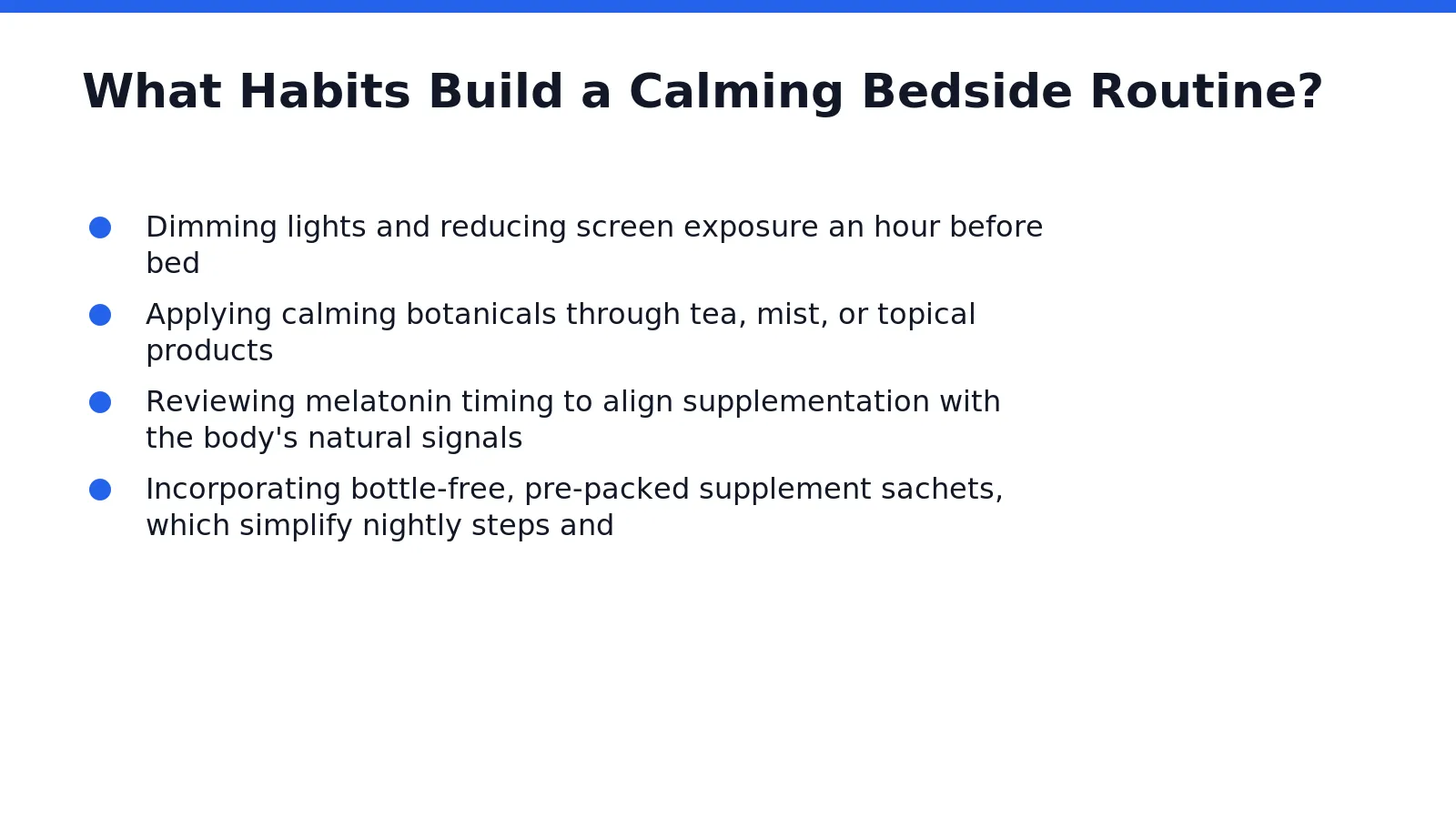
A Simple 4-Step Evening Reset
Finish urgent tasks, write down tomorrow’s priorities, and stop trying to hold them in working memory.
Dim lights, reduce intense media, and move away from work-mode activities.
Reading, prayer, breathing, stretching, a warm shower, journaling, or another low-stimulation ritual.
Keep it dark, quiet, cool, and associated primarily with sleep rather than another place to work or scroll.
Why Does Consistency Matter?
Sleep timing is influenced by repetition.
A wildly different sleep schedule every night forces the circadian system to keep adapting.
A relatively stable wake time can be especially useful because it anchors the beginning of the daily cycle.
The same behavioral principle applies to supplementation: reducing unnecessary decisions can make a routine easier to repeat.
For more on habit design, read The Pharmacist’s Morning Routine .
Where Does Magnesium Fit?
Magnesium is an essential mineral involved in hundreds of enzymatic reactions, including normal neuromuscular function and energy metabolism.
That makes adequate magnesium intake important.
It does not automatically make magnesium a sleep medication.
Magnesium Belongs in the Mineral Conversation — Not the “Knock Me Out” Conversation.
Research on magnesium supplementation and sleep has produced mixed results. Someone with inadequate magnesium intake may have a different situation than someone who already meets their needs. ProofMode uses magnesium as part of foundational mineral support rather than promising that magnesium alone will solve insomnia.
For the biochemical rationale behind evening mineral placement, read Magnesium & Zinc at Night: The Biochemical Rationale Behind the Core 5 Advantage .
PM Mineral Add-On — Magnesium + Zinc
For people who want the standalone PM Magnesium + Zinc component without purchasing the entire Complete Core 5 system.
Explore PM Mineral Add-On →What If You Want the Full AM + PM Foundation?
That is where Complete Core 5 Foundation fits.
Explore Complete Core 5 Foundation or compare it directly with Core 3 Foundation .
For the side-by-side breakdown, read Core 3 vs Complete Core 5: Which Is Right for You? .

What About Calming Botanicals?
Herbs have been part of nighttime rituals for centuries.
Common examples include:
- valerian
- chamomile
- lavender
- lemon balm
- passionflower
But “traditionally used for sleep” and “proven insomnia treatment” are not the same statement.
Clinical evidence varies considerably by botanical, preparation, dose, population, and outcome measured.
Think of Botanicals as Targeted Support — Not the Foundation of Sleep.
If a botanical product fits someone's routine, it should complement the basics: adequate time for sleep, circadian consistency, light management, caffeine timing, bedroom environment, and evaluation of persistent sleep problems.
When Does Precision Drift Make Sense?
Sometimes the biggest obstacle is not knowledge.
It is friction.
Someone wants a simple targeted bedtime option without another large bottle, water glass, or complicated nighttime stack.
Precision Drift — Sleep Support Strips
A fast-dissolving nighttime format combining melatonin with valerian, lavender, chamomile, and hibiscus for people who want a lower-friction bedtime support option.
Explore Precision Drift →What Is Melatonin Actually For?
Melatonin is often marketed as though it were simply a stronger sleep switch.
Physiologically, it is better understood as a circadian timing signal.
That means timing matters.
Taking melatonin without considering why sleep is difficult can miss the point.
More Melatonin Is Not Automatically Better.
Melatonin's effects depend on dose, timing, individual sensitivity, and the sleep problem being addressed. It should not be treated as though taking a larger amount necessarily produces better sleep.
What If You Want a Broader Nighttime System?
A strip may fit someone who wants one highly convenient targeted tool.
Another person may prefer a broader nighttime routine with multiple ingredients serving different roles.
ProofMode Sleep Pack
A broader nighttime-support approach for people who want more than a single targeted strip and prefer an organized evening system.
Explore the Sleep Pack →Which Nighttime Option Fits the Actual Need?
| If You Want... | Consider... |
|---|---|
| Basic evening Magnesium + Zinc | PM Mineral Add-On |
| The full AM + PM nutritional foundation | Complete Core 5 |
| A simple fast-dissolving targeted bedtime option | Precision Drift |
| A broader targeted nighttime system | ProofMode Sleep Pack |
There Is No Automatic “Next Step.”
Someone who sleeps well does not need to add a sleep product just because it exists. Precision means choosing the tool that matches the problem — and sometimes choosing no additional product at all.
What If the Problem Is Chronic Insomnia?
This is where a wellness article needs to know its limits.
Chronic insomnia is more than having a few restless nights.
If someone has persistent difficulty falling asleep, staying asleep, waking too early, or getting restorative sleep despite having adequate opportunity for sleep — especially when it causes daytime impairment — the solution may require more than better bedtime habits or another supplement.
CBT-I Is the Evidence-Based First-Line Treatment for Chronic Insomnia.
Cognitive Behavioral Therapy for Insomnia goes beyond basic “sleep hygiene.” It can include stimulus control, sleep-restriction therapy, cognitive strategies, relaxation, and structured sleep education.
That does not mean nighttime routines are useless.
It means a routine should not be marketed as a substitute for appropriate treatment when someone has an actual sleep disorder.
When Should Someone Look Beyond Supplements?
Sleep problems can reflect much more than a missing bedtime ingredient.
Consider medical evaluation when sleep problems are persistent or accompanied by issues such as:
- loud snoring or witnessed breathing pauses
- gasping during sleep
- severe daytime sleepiness
- restless or uncomfortable legs
- persistent insomnia
- major mood changes
- pain that repeatedly disrupts sleep
- new sleep problems after a medication change
Do Not Use “Sleep Support” to Hide a Sleep Disorder.
Obstructive sleep apnea, chronic insomnia, medication effects, restless legs, pain, depression, anxiety, reflux, nocturia, and other conditions can all disrupt sleep. The right next step may be evaluation rather than a stronger supplement.
Where Does “Foundations First” Fit?
Sleep is itself part of the foundation.
A supplement routine should not be used to compensate for:
- five hours in bed
- late-night work every night
- heavy caffeine late in the day
- a bright bedroom
- untreated sleep apnea
- an inconsistent sleep schedule
Read Foundations First: A Smarter Supplement Strategy for the larger ProofMode framework.
Why Does Low-Friction Packaging Matter at Night?
Because bedtime is the worst time to build a complicated routine.
You are tired.
Decision-making is low.
The goal should be fewer steps — not another supplement project.
Pre-portioned sachets and dissolvable strips can simplify the logistics by reducing bottle handling, pill counting, and travel clutter.
Convenience Can Support a Habit. It Cannot Guarantee One.
Sachets and strips remove several points of friction, but adherence still depends on whether the routine fits the person and whether there is a meaningful reason to keep doing it.
Read more about the behavioral side of supplementation in The Daily Sachet System and The Supplement Graveyard .
Different Sleep Problems Need Different Tools.
Explore ProofMode's targeted nighttime options without treating every restless night as the same problem.
Explore Sleep & Recovery →The ProofMode Evening Framework
No supplement can manufacture hours that never made it into the schedule.
Keep wake and sleep timing reasonably consistent.
Dim lights and reduce work, screens, caffeine, and other alerting inputs.
Cool. Dark. Quiet. Comfortable.
Minerals, melatonin, botanicals, or another tool should solve an identifiable problem — not simply enlarge the routine.
Persistent insomnia, apnea symptoms, or unexplained daytime sleepiness deserves evaluation.
Frequently Asked Questions
What is an evening wind-down routine?
An evening wind-down is a repeatable period of lower stimulation before sleep. It can include dimmer light, less intense screen use, quiet activity, a consistent schedule, and a sleep-friendly bedroom environment.
How long should I wind down before bed?
There is no single required duration. For many people, roughly 30–60 minutes of lower stimulation is a practical starting point, but consistency and fit matter more than hitting a precise number.
Do screens ruin sleep?
Not automatically, but bright light, stimulating content, work, social interaction, and delaying bedtime can all interfere with the transition toward sleep. Reducing those inputs late in the evening can help.
Does magnesium help sleep?
Magnesium is an essential mineral involved in normal neuromuscular and metabolic function. Research specifically examining magnesium supplementation for sleep has produced mixed results, so it should not be presented as a universal insomnia treatment.
What is the difference between PM Mineral Add-On and Complete Core 5?
PM Mineral Add-On is the standalone Magnesium + Zinc evening component. Complete Core 5 combines Core 3 Foundation in the morning with that separate PM Mineral Add-On at night.
What is Precision Drift?
Precision Drift is ProofMode's fast-dissolving targeted nighttime strip containing melatonin and a botanical blend. It is designed as a convenient bedtime-support option rather than a replacement for healthy sleep habits or treatment of a sleep disorder.
Are calming botanicals proven to treat insomnia?
Evidence varies considerably by botanical, formulation, dose, population, and outcome. They may fit a nighttime routine for some people, but they should not be treated as equivalent to evidence-based insomnia therapy.
What is the best treatment for chronic insomnia?
Cognitive Behavioral Therapy for Insomnia — CBT-I — is considered a first-line evidence-based treatment for chronic insomnia in adults. It goes beyond basic sleep hygiene and can include stimulus control, sleep-restriction therapy, cognitive strategies, relaxation, and structured sleep education.
When should sleep problems be medically evaluated?
Persistent insomnia, loud snoring, witnessed breathing pauses, gasping during sleep, significant daytime sleepiness, recurrent restless-leg symptoms, unexplained nighttime behaviors, or substantial functional impairment deserve appropriate medical evaluation.
Don’t Chase Sleep. Build the Conditions for It.
Protect enough time. Anchor the schedule. Dim the environment. Reduce the stimulation. Keep the routine simple. Then, if a targeted product has a clear job, add it with purpose.
The Takeaway
Good sleep is not built from one ingredient.
It emerges from timing, light, sleep opportunity, behavior, environment, health, and — when appropriate — targeted support.
Magnesium is a foundational mineral, not a knockout drug.
Melatonin is a circadian signal, not simply a stronger sedative.
Botanicals may have a role, but the evidence depends on the actual botanical and formulation.
And chronic insomnia deserves something stronger than another sleep-hygiene checklist.
Build the conditions. Reduce the friction. Add precision when it has a job.
This article is for educational purposes only and is not medical advice. Sleep problems can result from medical conditions, medications, mental-health conditions, circadian disorders, sleep apnea, restless legs, pain, substance use, and other causes. Dietary supplements are not substitutes for appropriate evaluation or evidence-based treatment of a sleep disorder. Discuss persistent sleep problems and significant changes in sleep with an appropriate healthcare professional.


