


The Supplement Industry Does Not Need More Confidence. It Needs More Context.
ProofMode Labs was built around a simple idea: consumers deserve to know what they are taking, why an ingredient is there, what the evidence actually shows, where the uncertainty begins, and when a supplement is the wrong tool entirely.
What Does “Pharmacist-Led” Mean at ProofMode Labs?
It does not mean that a Pharm.D. title magically makes every supplement effective.
It means pharmacist training informs how we evaluate ingredient claims, dosing, interactions, duplication, safety, evidence strength, product architecture, and consumer education.
The goal is not to make supplements sound more impressive. The goal is to make the decision around them more intelligent.
Key Takeaways
Companies are responsible for product compliance, truthful labeling, safety obligations, and appropriate manufacturing practices.
Dose, formulation, population, endpoint, and actual finished-product testing matter.
Training in pharmacology makes interactions, dose, contraindications, and evidence limitations harder to ignore.
Uncertainty is not a weakness. Pretending uncertainty does not exist is.
Start broad only where broad coverage makes sense. Add targeted precision when there is a reason.
If we cannot clearly explain what problem a product is meant to solve, it has not earned a place in the routine.
Why ProofMode Labs Exists
The supplement market has no shortage of products.
What it often lacks is context.
Consumers see phrases like:
- clinically proven
- maximum absorption
- doctor formulated
- detoxifying
- hormone balancing
- immune boosting
- metabolism optimizing
- anti-aging
Those phrases can sound scientific while revealing surprisingly little.
Show Me the Receipts.
What ingredient? What dose? Which form? Studied in whom? Compared with what? For which endpoint? For how long? And was that evidence generated using this finished product — or merely an ingredient that happens to appear somewhere on the label?
What Does Radical Transparency Actually Mean?
Transparency is not simply posting an ingredient list.
A label is the beginning of the conversation.
Useful transparency asks:
- What is in the product?
- How much is in each serving?
- What form is the ingredient in?
- What is the intended nutritional role?
- What does human evidence support?
- What does it not support?
- What are the meaningful safety considerations?
- What medications or other supplements may interact?
- Who should probably not use it?
Tell Me What It Is. Tell Me Why It's There. Tell Me How Strong the Evidence Is.
Then tell me where the evidence stops.
The Regulatory Reality Consumers Should Understand
Dietary supplements are regulated differently from prescription drugs.
FDA does not generally approve dietary supplements for safety and effectiveness before they are sold.
Instead, companies have responsibilities that include:
- ensuring products comply with applicable safety requirements
- ensuring labeling is not false or misleading
- following applicable current good manufacturing practices
- properly identifying dietary ingredients and amounts
- supporting structure/function claims with appropriate substantiation
“FDA Regulated” and “FDA Approved” Are Not the Same Thing.
Dietary supplements are subject to FDA regulation, but FDA generally does not approve them for safety and effectiveness before they reach the consumer.
Marketing Claims Need Evidence Too.
FTC requires advertising to be truthful and not misleading.
Objective health claims need adequate substantiation.
For health-related claims, that generally means:
competent and reliable scientific evidence.
That standard matters because consumers cannot personally verify many health claims.
An Ingredient Study Does Not Give You Permission to Say Anything You Want About the Bottle.
The dose, formulation, population, outcome, duration, and actual claim all have to match the evidence closely enough to remain truthful.
What Does a Pharmacist Add to the Conversation?
Pharmacists are trained to think in:
- dose
- pharmacology
- absorption
- metabolism
- interactions
- contraindications
- adverse effects
- evidence quality
- monitoring
Those habits translate naturally into supplement review.
But a pharmacist title does not transform a weak ingredient into a strong one.
It should instead make the questions harder.
Pharmacist-Led Should Mean More Scrutiny.
More attention to interactions. More skepticism about proprietary blends. More awareness of duplicated ingredients. More concern when a supplement begins to sound like an unapproved drug claim. More willingness to say, “You may not need this.”
Who Is Justin Curnutt, Pharm.D.?
Justin Curnutt is a pharmacist and the founder behind ProofMode Labs.
ProofMode is built around a pharmacist-informed approach to supplement education:
- start with evidence
- understand the mechanism without overselling it
- separate biological plausibility from demonstrated clinical outcomes
- identify meaningful safety and interaction issues
- make the regimen simpler when possible
- use targeted products only when the target is defined
Foundation First. Precision When There Is a Reason.
Cover broad nutritional needs when appropriate. Define the specific problem. Choose the tool that actually addresses it. Then reassess instead of adding supplements forever.
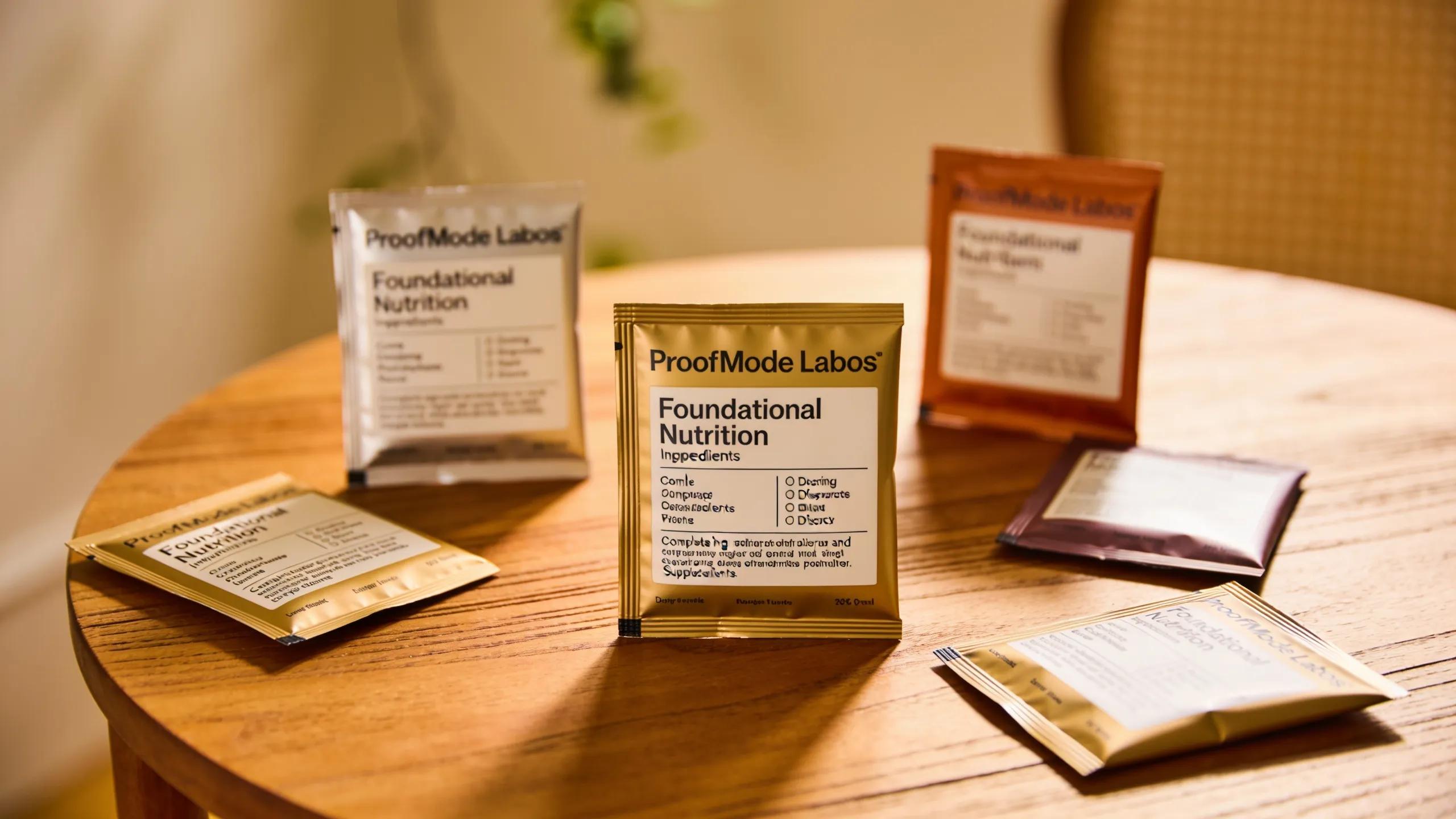
Ingredient Evidence vs Finished-Product Evidence
This distinction is critical.
Imagine a study finds that:
5 grams of Ingredient X improves Outcome Y.
Your supplement contains Ingredient X.
Great.
But now ask:
- Does your serving contain 5 grams?
- Is it the same chemical form?
- Was the same population studied?
- Was the endpoint the same?
- Was the finished product itself tested?
If the answers are no, you cannot simply borrow the study's conclusion and staple it to the label.
What We Want You to Be Able to See on a ProofMode Page
The goal is that you can answer:
No vague “proprietary wellness system” when plain English will do.
Ingredient identity and disclosed amounts whenever available.
Mechanism and intended nutritional role separated from guaranteed outcomes.
Human data prioritized over mechanistic storytelling.
No hiding the limitations because they hurt the sales pitch.
Interactions and safety should not be buried beneath the Buy button.
What About Third-Party Testing?
Third-party testing can be valuable.
But the phrase should only be used when it is actually documented for the specific product or batch being discussed.
“Third-party tested” can mean different things:
- identity testing
- potency testing
- microbial testing
- heavy-metal testing
- contaminant screening
- finished-product verification
Those are not interchangeable claims.
Transparency Includes Not Claiming Testing We Cannot Show You.
ProofMode should only use specific testing, certification, COA, laboratory, or quality-system claims when the documentation for that exact claim is available.
Supplier Claims vs ProofMode Claims
Private-label products often arrive with:
- supplier descriptions
- ingredient badges
- marketing claims
- sourcing language
Those claims still need scrutiny.
If a supplier says:
“optimal absorption”
we should ask:
compared with what?
If the supplier says:
“allergen-free”
we should ask whether documentation actually supports that categorical claim.
What Does “Foundation First” Mean?
Foundation does not mean:
“Everyone needs the same five supplements.”
It means start with the basic questions:
- Is the diet reasonably complete?
- Is protein adequate?
- Are there obvious dietary gaps?
- Are medications changing nutrient risk?
- Are labs or symptoms pointing to a specific deficiency?
- Is the supplement solving a defined problem?
Cover the Foundation. Define the Problem. Choose the Tool. Reassess.
Complexity should have to earn its place.
Where Does Core 3 Fit?
Core 3 is one ProofMode approach to broad foundational supplementation.
Core 3 Foundation
Core 3 organizes a multivitamin, omega-3, and probiotic/prebiotic support into a simplified AM routine.
That does not mean every adult universally needs all three categories. It means adults who want those categories covered can use a simpler delivery system instead of managing multiple separate bottles.
Explore Core 3 →What About Complete Core 5?
Complete Core 5 is not:
“Core 3 plus advanced herbal extracts.”
It is much simpler.
Core 3 + PM Magnesium + Zinc.
Complete Core 5 Foundation
Complete Core 5 combines the Core 3 morning foundation with the separate PM Magnesium + Zinc Add-On.
It is broader than Core 3 — not automatically better. The additional minerals should fit the person's diet, existing supplements, medications, and goals.
Explore Complete Core 5 →PM Mineral Add-On
Already have the daytime foundation handled? PM Mineral Add-On provides the separate magnesium + zinc layer without requiring the full Core 5 system.
Explore PM Mineral Add-On →Foundation vs Targeted Precision
| Layer | Question | Examples |
|---|---|---|
| Food Foundation | Is the overall diet doing its job? | Protein, plants, fiber, fats, calories |
| Supplement Foundation | Is broad nutritional coverage appropriate? | Core 3 / Complete Core 5 |
| Targeted Precision | What defined problem needs a specific tool? | Creatine, magnesium, protein, CoQ10, hydration, sleep support |
What Transparency Does NOT Mean
It does not mean every ingredient is guaranteed to work for you.
Human biology does not work that way.
It does not mean every product has been independently clinically tested.
Ingredient evidence and finished-product evidence must be distinguished.
It does not mean pharmacist-led equals pharmacist-prescribed.
Education and product review are not substitutes for individualized medical care.
It does not mean more ingredients are better.
More ingredients create more opportunities for overlap, interactions, and underdosing.
It does not mean uncertainty should be hidden.
If the evidence is mixed, early, observational, mechanistic, or product-specific, say so.
How to Evaluate Any Supplement — ProofMode or Otherwise
Start with the problem, not the product.
Mechanisms are interesting. Outcomes matter more.
An ingredient name on a label does not prove an evidence-based dose.
Audit duplicate vitamin D, magnesium, zinc, B vitamins, caffeine, botanicals, and other active ingredients.
“Natural” does not mean interaction-free.
A supplement should not become permanent simply because nobody remembered to ask whether it still has a job.
Why Education Comes Before the Product
A good educational article should sometimes lead to:
“This product may fit.”
Sometimes:
“You probably need a different product.”
And sometimes:
“This is not a supplement problem.”
If every educational article ends with the same product recommendation, it was not really education.
Trust Is Not “Believe Us.” Trust Is “Here Is Enough Information to Check Us.”
Good supplement education should make the customer more capable of questioning the brand — including ProofMode.
Related ProofMode Guides
The full ProofMode framework for foundation → defined problem → targeted precision.
Read Foundations First →See exactly what changes between the two foundations — without calling broader automatically better.
Compare the Foundations →What convenience really solves — and why packaging does not change pharmacology.
Read the Sachet Guide →Why every supplement should have a defined job — and why complexity should earn its place.
Read the Supplement Graveyard →Frequently Asked Questions
Is ProofMode Labs pharmacist-formulated?
ProofMode Labs is pharmacist-led and pharmacist-informed. Pharmacist training shapes the educational framework, claim review, safety considerations, product architecture, and how ingredients are discussed. ProofMode does not imply that every individual finished product was personally formulated from raw ingredients by a pharmacist unless that is specifically documented.
Are dietary supplements FDA approved?
Generally, no. FDA does not approve dietary supplements for safety and effectiveness before marketing in the same manner as prescription drugs. Supplement companies remain responsible for complying with applicable safety, labeling, manufacturing, and claim requirements.
Does FDA regulate dietary supplements?
Yes. Dietary supplements are regulated by FDA, but the regulatory framework differs substantially from the premarket approval process used for drugs.
What does “evidence-based supplement” mean?
It should mean that the specific claim is reasonably supported by relevant scientific evidence. Ingredient evidence, dose, formulation, study population, endpoint, and finished-product evidence should not be treated as interchangeable.
Are all ProofMode Labs products third-party tested?
ProofMode should only make product-specific third-party-testing claims when documentation supports that claim for the relevant product or batch. Testing claims should identify what was actually tested whenever that information is available.
Is Core 3 designed for everyone?
No. Core 3 is a broad AM nutritional foundation for adults who want multivitamin, omega-3, and probiotic/prebiotic categories organized together. Individual dietary needs still vary.
What is the difference between Core 3 and Complete Core 5?
Core 3 is the AM foundation. Complete Core 5 combines Core 3 with a separate PM Magnesium + Zinc component. Core 5 does not add herbal extracts.
Is Complete Core 5 better than Core 3?
Not automatically. Complete Core 5 is broader because it adds magnesium and zinc. Whether those additional minerals are appropriate depends on the person's diet, medications, existing supplements, and goals.
Does ProofMode guarantee supplement results?
No. Supplement response varies by individual, diet, baseline nutrient status, dose, formulation, adherence, medical conditions, medications, and the outcome being measured.
Why does ProofMode sometimes say not to use a product?
Because the purpose of evidence-based education is to improve the decision, not force every reader toward a sale. Sometimes another product fits better. Sometimes food or medical evaluation is the better answer. Sometimes no supplement is needed.
Regulatory + Evidence Standards
FDA — Dietary Supplement Regulation.
FDA does not generally approve dietary supplements for safety and effectiveness before marketing. Companies are responsible for ensuring their products comply with applicable law and are not adulterated or misbranded.
FDA Dietary Supplement Q&A →
FDA — Current Good Manufacturing Practices.
Dietary supplement manufacturers, packagers, and holders are subject to current good manufacturing practice requirements intended to support identity, purity, quality, strength, and composition.
FDA Supplement Requirements →
Federal Trade Commission — Health Products Compliance Guidance.
Health-related advertising must be truthful, not misleading, and adequately substantiated. Objective safety and efficacy claims generally require competent and reliable scientific evidence appropriate to the claim being made.
FTC Health Products Guidance →
Know the Model. Know the Endpoint. Know the Evidence Level.
Supplements do not need louder marketing. They need clearer explanations, better context, more honest limitations, and fewer claims that outrun the evidence.
The Takeaway
ProofMode Labs is pharmacist-led, not pharmacist-magic.
A professional credential does not replace evidence.
Ingredient evidence does not automatically prove a finished product.
Supplier marketing does not automatically become ProofMode marketing.
Testing claims should only be made when they can be documented.
Core 3 provides one broad AM foundation.
Complete Core 5 is Core 3 plus PM magnesium + zinc.
Targeted products belong after the problem is defined.
Education should sometimes lead to a product — and sometimes lead away from one.
Tell me what it is. Tell me why it's there. Tell me how strong the evidence is.
This article is for educational purposes only and is not medical advice. Dietary supplement needs and safety vary with diet, age, pregnancy status, medications, medical conditions, kidney and liver function, allergies, nutrient status, and individual goals. ProofMode Labs educational content is intended to help consumers understand evidence, product roles, limitations, and safety considerations; it does not replace individualized diagnosis or treatment from an appropriate healthcare professional.


