


Parents Thought They Were Giving Their Kids Magnesium. Regulators Found Undeclared Melatonin.
In August 2025, the UK Medicines and Healthcare products Regulatory Agency — MHRA — advised parents and caregivers to stop using Nutrition Ignition Kids Magnesium Glycinate Gummies after laboratory testing detected melatonin that was not disclosed on the product label.
This is not a story about magnesium being dangerous.
It is not even primarily a story about melatonin being dangerous.
It is a story about something more basic:
When an active ingredient is present but absent from the label, the consumer loses the ability to make an informed decision about:
- what is being taken
- how much is being taken
- possible medication interactions
- possible adverse effects
- whether the ingredient was wanted in the first place
What Actually Happened With the Magnesium Gummies?
On August 18, 2025, the MHRA issued a safety alert regarding Nutrition Ignition Kids Magnesium Glycinate Gummies.
The agency tested two batches of the product.
Melatonin was detected in both.
The melatonin was not listed on the packaging.
Depending on the child's age, the product directions recommended one or two gummies per day.
The product was marketed for children age four and older for “calm, focus, and digestion.”
You can read the MHRA's official safety notice here →
Melatonin Is a Prescription-Only Medicine in the UK.
Because the gummies contained melatonin, the MHRA stated that the product could not simply be treated as an ordinary food supplement. In the UK, melatonin is a medicine available on prescription rather than an over-the-counter dietary supplement.

Why Does Undeclared Melatonin Matter?
Because the person taking the product — or the parent giving it to a child — never chose that exposure.
A caregiver who buys a magnesium supplement can reasonably expect:
- magnesium to be disclosed
- the amount to be disclosed
- other active ingredients to be disclosed
- instructions to reflect the actual contents
Hidden melatonin breaks that chain of informed choice.
The Problem Is Undeclared Exposure — Not “Melatonin Is Poison.”
Melatonin has legitimate medical uses and can be prescribed to selected children under specialist care. The safety failure here was that a prescription-only medicine was present in a product whose label did not disclose it.
What Effects Did Regulators Warn Parents About?
The MHRA noted that reported effects of prescribed melatonin in children can include:
- headache
- hyperactivity
- dizziness
- abdominal pain
The agency also noted that serious adverse effects had not been observed in studies of melatonin used in children for its licensed indications.
This Is a Reason to Act — Not a Reason to Panic.
The official advice was to stop using the product, safely dispose of it, and seek healthcare advice if a child experiences side effects that are concerning.
What Should Parents Do if They Still Have the Gummies?
Do not continue using it simply to finish the container.
The MHRA advised storing remaining product securely until it can be disposed of.
UK guidance advises taking the product to a pharmacy for disposal.
A pediatrician, physician, pharmacist, or appropriate local medical service can help assess unexpected symptoms.

Does Finding Melatonin in Two Batches Prove the Entire Supplement Industry Is Unsafe?
No.
That conclusion would go beyond the evidence.
The MHRA finding tells us something very specific:
two tested batches of one children's magnesium gummy product contained undeclared melatonin.
That is serious.
It does not prove every magnesium gummy is adulterated, every supplement manufacturer is unreliable, or every gummy product is unsafe.
One Bad Product Is Not an Indictment of an Entire Category. It Is a Reminder to Verify What You Can.
Good supplement evaluation avoids both extremes: blindly trusting every label and assuming every product is secretly contaminated.
What Can Consumers Realistically Verify?
Consumers cannot independently chemically analyze every supplement they buy.
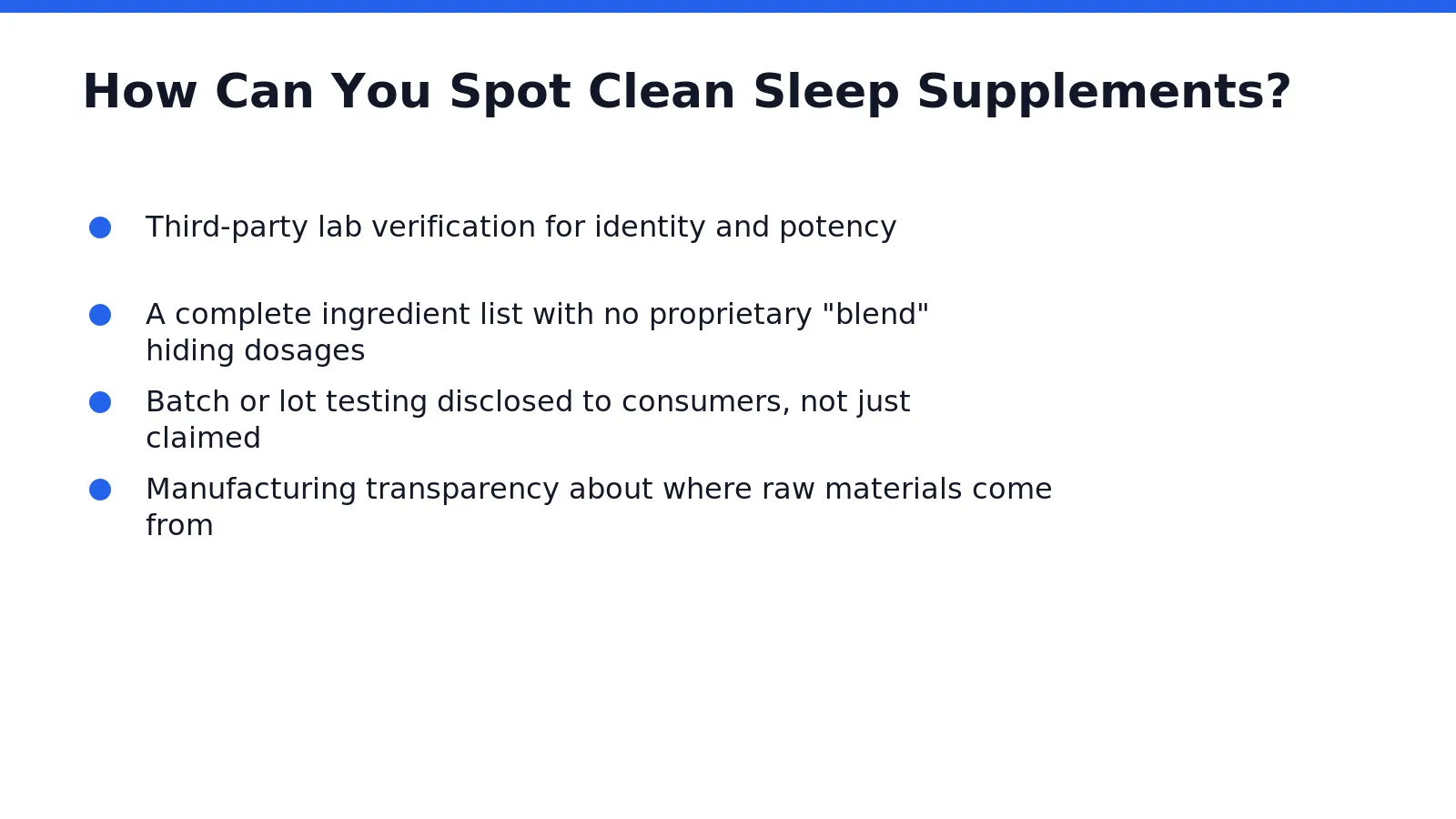
But they can look for stronger transparency.
Every active ingredient should appear clearly on the label.
Consumers should be able to understand how much of an active nutrient they are taking.
Traceability matters when a quality issue needs to be investigated.
If a company claims third-party testing, ask what was tested, by whom, and whether results apply to the finished product or current lot.
A company should be able to answer reasonable questions about ingredients and quality controls.
“Third-Party Tested” Does Not Automatically Mean “Tested for Every Hidden Drug.”
Testing programs differ. Identity testing, potency testing, heavy-metal testing, microbiology, undeclared-drug screening, and contaminant panels are separate analyses. Ask what a testing claim actually covers.
Are Proprietary Blends Automatically Suspicious?
Not automatically.
But they can make it harder to know how much of each ingredient is present.
Transparency is especially valuable when a product is marketed for sleep, mood, children, or another use where active ingredients may materially affect the body.
Does This Safety Alert Mean Magnesium Glycinate Is a Problem?
No.
The issue was not magnesium glycinate itself.
Magnesium is an essential mineral involved in normal neuromuscular function, metabolism, and hundreds of enzymatic reactions.
The problem was that the product contained an additional active ingredient that was not disclosed.
Vital Calm — Magnesium Glycinate
For adults looking specifically for magnesium glycinate rather than a sleep gummy or multi-ingredient bedtime formula, start by evaluating the ingredient panel, serving information, and whether the product fits your actual magnesium needs.
Explore Vital Calm — Magnesium Glycinate →Adult Magnesium Products and Children's Sleep Products Are Different Decisions.
A children's product deserves age-appropriate review. An adult magnesium product should not be treated as a substitute for pediatric guidance simply because the active mineral is the same.
Does Magnesium Automatically Improve Sleep?
No.
Magnesium is an essential nutrient, but current randomized-trial evidence does not support treating magnesium as a universal insomnia therapy.
That distinction matters because consumers often buy magnesium specifically because the product is framed as a sleep aid.
For a fuller discussion, read Magnesium & Zinc at Night: The Biochemical Rationale Behind the Core 5 Advantage →
What if Someone Wants Magnesium + Zinc Rather Than a Sleep Formula?
That is a different product goal.
PM Mineral Add-On — Magnesium + Zinc
A standalone evening mineral option for adults who want Magnesium + Zinc without turning the product into a melatonin-based sleep formula.
Explore PM Mineral Add-On →And What Is Complete Core 5?
Complete Core 5 is ProofMode's full AM + PM foundational system:
Complete Core 5 Foundation
Core 3 Foundation plus the separate PM Mineral Add-On.
Explore Complete Core 5 →A Sleep Product Should Not Replace a Sleep Strategy
Whether someone uses magnesium, melatonin, botanicals, or no nighttime supplement at all, the broader sleep foundation still matters:
- enough time allocated for sleep
- consistent sleep and wake timing
- evening light management
- caffeine timing
- a dark, quiet, cool bedroom
- evaluation of persistent insomnia or sleep apnea symptoms
Read Building an Intentional Evening Wind-Down for Better Rest →
Different Problems Need Different Tools.
A mineral gap, an inconsistent nighttime routine, and chronic insomnia are not the same problem. Start with the actual need before choosing a product.
Explore Sleep & Recovery →What Should “Pharmacist-Led” Mean?
It should not mean:
“Trust this product because a pharmacist is associated with the brand.”
Credentials do not replace evidence.
A more defensible pharmacist-led standard is:
Foundation First. Precision When There Is a Reason.
The goal is not to collect more supplements. It is to understand what is being taken, why it is being taken, and whether the evidence and product quality justify keeping it in the routine. Read Foundations First →
Frequently Asked Questions
What was found in Nutrition Ignition Kids Magnesium Glycinate Gummies?
The UK MHRA reported that testing of two batches detected undeclared melatonin. The tested gummies contained approximately 1.5–1.7 mg of melatonin per individual gummy even though melatonin was not listed on the label.
Was melatonin allowed in the product?
In the UK, melatonin is a prescription-only medicine. The MHRA stated that detecting melatonin meant the product could not simply be marketed as an ordinary food supplement.
Does this mean melatonin is unsafe for children?
No. Melatonin can be prescribed to selected children under specialist medical care. The issue in this case was that parents were not told the product contained it and therefore could not make an informed dosing or medication decision.
What side effects did the MHRA mention?
The MHRA noted that headache, hyperactivity, dizziness, and abdominal pain have been reported when melatonin is prescribed to children. Serious side effects had not been observed in pediatric studies cited by the agency.
What should parents do if they still have the affected product?
The MHRA advised parents and caregivers to stop giving the product to children, store it securely until disposal, and take remaining product to a pharmacy for safe disposal. Healthcare advice should be sought if a child has concerning symptoms.
Does third-party testing guarantee there are no hidden ingredients?
No. Testing only answers the questions actually included in the test panel. Heavy-metal screening, microbiology, nutrient potency, identity testing, and undeclared-drug screening are different analyses. Ask what a testing claim specifically covers.
Does this incident mean magnesium gummies are unsafe?
No. It means one named children's product had a serious labeling and quality problem identified by regulators. It should not be generalized to every magnesium gummy or every magnesium supplement.
Is magnesium glycinate itself a sleep drug?
No. Magnesium is an essential mineral involved in normal neuromuscular and metabolic function. Some adults use magnesium glycinate in evening routines, but current evidence does not establish magnesium as a universal treatment for insomnia.
What should I look for when choosing a magnesium supplement?
Look for a clear ingredient list, understandable serving information, lot identification, manufacturer transparency, and specific information about any testing claims. Also consider whether you actually need supplemental magnesium and whether medical conditions or medications affect the choice.
The Problem Was Not “Magnesium Gummies.” The Problem Was a Label That Did Not Tell the Truth.
Good supplement decisions require both sides of the equation: a formulation that makes biological sense and a finished product that actually contains what the label says it contains.
The Takeaway
Two tested batches of one children's magnesium gummy product contained undeclared melatonin.
That deserves attention.
It does not justify fear of magnesium itself.
Melatonin is a legitimate medicine, but undisclosed melatonin removes informed choice.
Testing matters — but consumers should understand what was actually tested.
And one product failure should not be turned into a marketing weapon against an entire supplement category.
Read the label. Ask what was tested. Verify the claim. Then decide whether the product earns your trust.
This article is for educational purposes only and is not medical advice. The regulatory action discussed here relates specifically to Nutrition Ignition Kids Magnesium Glycinate Gummies and should not be generalized to all magnesium or gummy supplements. Melatonin regulation varies by country; in the United Kingdom it is a prescription-only medicine. Children should not be given supplements or sleep products solely on the basis of general online advice. If a child has taken the affected product and develops concerning symptoms, seek appropriate medical advice.


