


“Third-Party Tested” Sounds Reassuring. It Is Also an Incomplete Sentence.
Tested for what? Which lot? Using which method? Who selected the sample? Was the laboratory accredited for that specific test? What were the actual numerical results? A laboratory report can be extremely useful — but only when you understand what question the test actually answered.
Can a Supplement Lab Have a Conflict of Interest?
Yes. Any laboratory can face financial, organizational, operational, or relationship-based pressures that create risks to impartiality.
But a manufacturer paying a commercial laboratory to perform testing does not automatically make the result biased.
The better questions are whether the laboratory is competent for the test, whether impartiality risks are controlled, whether the method is appropriate, whether the sample is representative, and whether the report contains enough information to independently understand the result.
Key Takeaways
Identity, potency, heavy metals, microbes, pesticides, solvents, and banned substances are different analyses.
Commercial laboratories routinely test products for paying clients. The issue is whether impartiality risks are recognized and controlled.
A lab can be ISO/IEC 17025 accredited for certain methods without every analysis it offers falling within its accredited scope.
A manufacturer-selected sample, production-retained sample, regulator-collected sample, and anonymously purchased retail sample answer different questions.
Passing potency or contaminant testing does not establish that the supplement improves health.
“Passed” is less useful than the analyte, method, specification, result, unit, lot, laboratory, and date.
The Wrong Question: “Can We Trust Big Labs?”
Laboratory size is not a scientific quality metric.
A giant laboratory can produce excellent work.
A tiny independent laboratory can produce poor work.
And vice versa.
The more useful audit asks:
- Is the method appropriate?
- Is the laboratory competent for that method?
- Does the lab manage impartiality?
- Was the sample representative?
- Was chain of custody maintained?
- Were appropriate standards and controls used?
- What were the actual results?
Don't Audit the Logo. Audit the Process.
“Big lab,” “small lab,” “independent lab,” and “third-party lab” are descriptions. They are not substitutes for method competence, impartiality, appropriate sampling, and transparent reporting.
What Is ISO/IEC 17025?
ISO/IEC 17025 is an international standard used for testing and calibration laboratories.
It addresses:
- laboratory competence
- impartiality
- consistent operation
- method-related controls
- equipment and personnel requirements
- quality-system requirements
Accreditation Is More Useful Than a Vague “Independent Lab” Claim.
Accreditation bodies use ISO/IEC 17025 to assess whether a laboratory demonstrates competence and appropriate systems for testing within its accredited scope.
What Does “Impartiality” Mean?
Impartiality means objectivity.
It means conflicts of interest either:
- do not exist
- or are identified and controlled so they do not improperly influence laboratory activities
This distinction matters because:
financial relationship does not automatically equal corrupted result.
Laboratories still need systems designed to identify and manage risks to impartiality.
“But the Manufacturer Paid the Lab.” Is That a Conflict?
It can create an incentive that deserves controls.
But that is how commercial analytical testing often works.
A food company pays a lab.
A pharmaceutical company pays a lab.
A supplement company pays a lab.
The mere existence of payment does not establish that the laboratory falsified, softened, manipulated, or concealed a result.
Ask a Better Conflict Question.
Does the laboratory have systems protecting analysts and results from commercial pressure — and can it demonstrate impartiality, technical competence, method control, and proper reporting?

The Most Overlooked Question: Who Chose the Sample?
You can have an excellent laboratory and still ask the wrong question with the sample.
Consider four testing scenarios.
| Sample Source | What It Can Tell You | Limitation |
|---|---|---|
| Manufacturer-selected sample | Whether the submitted sample meets specifications | May not independently establish marketplace representativeness |
| Production representative sample | Batch-level manufacturing quality when sampled properly | Depends on sound sampling procedures |
| Anonymous retail purchase | What a consumer actually obtained from the market | One unit may not represent every lot |
| Regulator / auditor-collected sample | Independent sample under defined collection procedures | Still limited to the product / lot sampled |
A Perfect Test on a Nonrepresentative Sample Can Still Give You False Confidence.
Laboratory competence cannot compensate for poor sampling. What was tested matters just as much as how it was tested.
What Does FDA Actually Require From Supplement Manufacturers?
Dietary-supplement current good manufacturing practice regulations require manufacturers to establish specifications designed to ensure:
- identity
- purity
- strength
- composition
- appropriate limits on contaminants
Manufacturers also need appropriate testing or examinations and quality-control systems to verify that required specifications are met.
FDA requires dietary ingredient identity verification unless an authorized alternative applies.
Testing Is Part of a System — Not the Whole System.
Supplier qualification, specifications, representative sampling, manufacturing controls, laboratory methods, documentation, and quality-control review all contribute to finished-product quality.
What Is a Certificate of Analysis — and What Does It Prove?
A Certificate of Analysis, or COA, summarizes analytical results for a material or product.
A useful COA may include:
- product or material identity
- lot or batch number
- test performed
- test method
- specification or acceptance limit
- actual result
- units
- testing date
- laboratory identity
A COA Should Tell You More Than “PASS.”
The more specific the report is about analyte, method, specification, numerical result, units, sample identity, and lot, the easier it becomes to understand what was actually demonstrated.
Can a Manufacturer Rely on a Supplier's COA?
In some circumstances, yes.
But FDA's dietary-supplement cGMP framework does not reduce that to:
“The supplier sent us a PDF, so we're good.”
When manufacturers rely on supplier COAs for applicable component specifications, FDA requires supplier qualification procedures that include establishing the reliability of the supplier's COA and periodically reconfirming that reliability.
FDA guidance also describes COAs as including information such as:
- test methods
- test limits
- actual results
Why “Pass” vs “Fail” Can Hide Useful Information
Imagine a heavy-metal specification is:
less than 1.0 unit.
Product A measures:
0.05
Product B measures:
0.98
Both may technically read:
PASS
But the numerical result tells you considerably more.
Look for the Reporting Limit Too
Phrases such as:
- not detected
- below quantitation limit
- below detection limit
are not necessarily interchangeable with:
absolutely zero.
Analytical methods have limits of detection and quantitation.
Good interpretation requires knowing which one applies.
“Lab Tested” — For What?
| Test | Question |
|---|---|
| Identity | Is this ingredient actually what it claims to be? |
| Assay / Potency | How much of the declared active ingredient is present? |
| Heavy Metals | What are the measured elemental-contaminant levels? |
| Microbial Testing | Are specified microbial loads/pathogens within limits? |
| Pesticides | Are specified pesticide residues detected above limits? |
| Residual Solvents | Are specified manufacturing solvents present above limits? |
| Banned Substances | Does the product screen for specified substances relevant to drug-tested sport? |
What Lab Testing Does NOT Tell You
This may be the single most important distinction in the article.
Laboratory testing can help answer:
“What's in the product?”
It does not automatically answer:
“Does the product improve health?”
Clinical benefit requires a completely different evidence conversation.
Purity Is Not Efficacy.
A perfectly manufactured, accurately labeled, contaminant-controlled supplement can still contain an ingredient that does not meaningfully improve the outcome being advertised.
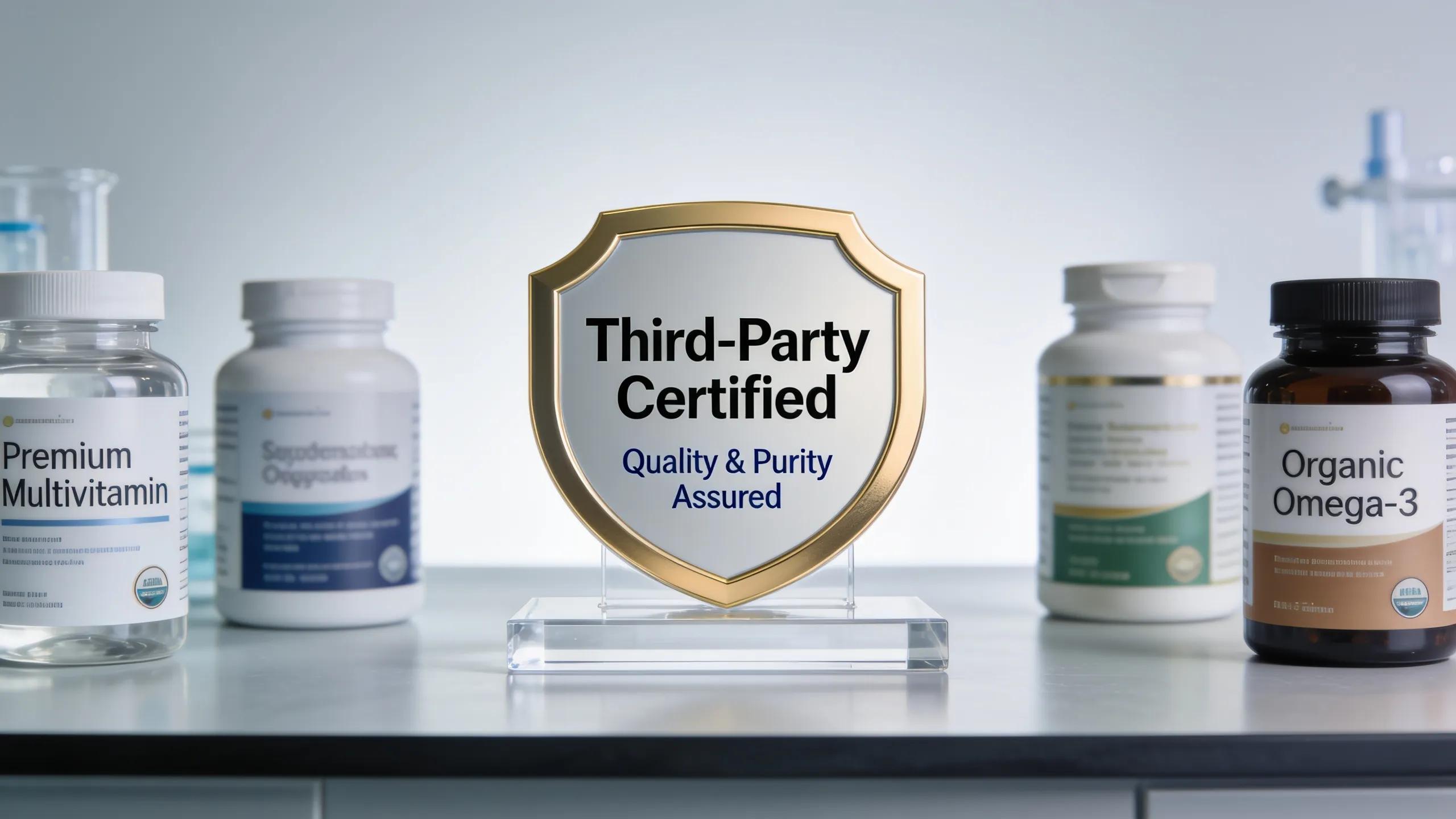
What About NSF, USP, and Other Certification Programs?
Certification can add a valuable layer of external verification.
But different programs answer different questions.
NSF
NSF dietary-supplement programs can include evaluation of label content, product composition, contaminants, manufacturing systems, and — for Certified for Sport — additional screening relevant to substances prohibited in sport.
USP Verified
USP's verification program is designed to assess characteristics including whether declared ingredients and amounts are present, specified contaminants remain within limits, manufacturing practices are appropriate, and the product meets specified performance criteria.
Quality Certification Does Not Mean “Clinically Proven.”
A certification mark can strengthen confidence in defined product-quality characteristics. It does not automatically prove that the supplement improves energy, sleep, cognition, immunity, muscle growth, or any other health outcome.
One Detail Almost Nobody Checks: The Laboratory's Accredited Scope
Saying:
“This lab is ISO/IEC 17025 accredited”
is useful.
But it is not the final question.
Ask:
Is this specific test or method inside the lab's accredited scope?
Accreditation applies to defined laboratory activities.
A lab may offer additional analyses outside the accredited scope.
HPLC and Mass Spectrometry Sound Impressive. Are They Enough?
No analytical instrument automatically guarantees a valid result.
HPLC, LC-MS, GC-MS, ICP-MS, and other technologies are powerful tools.
But the important question is:
Is the method scientifically appropriate and validated or verified for its intended use?
Instrument name alone does not establish:
- sample preparation quality
- specificity
- accuracy
- precision
- detection capability
- appropriate reference standards
- analyst competence
Is Blind Retail Testing Better?
It answers a valuable question:
“What did a consumer actually buy?”
That can reduce concern that the manufacturer deliberately submitted an unusually favorable sample.
But retail testing has its own limitation:
one bottle from one retailer may represent:
one lot.
It does not automatically establish the quality of every batch produced before or after it.
What Happens When a Result Fails?
This is another place where transparency matters.
Questions worth asking include:
- Was the original result investigated?
- Was the same sample retested?
- Was a new sample pulled?
- Was another method used?
- Was another laboratory consulted?
- Was the lot released, rejected, reworked, or destroyed?
Testing Is Most Interesting When Something Goes Wrong.
Quality systems are not judged only by how they generate passing results. They are also judged by how they investigate unexpected, out-of-specification, or conflicting results.
What Should ProofMode Labs Say About Testing?
Only what can be documented.
That means avoiding vague brand-wide statements such as:
“Every ProofMode product is independently lab tested.”
unless there is documentation supporting that statement for the entire catalog.
A stronger approach is product-specific.
If documentation exists, say exactly:
- what was tested
- which lot was tested
- which laboratory performed the analysis
- what the test measured
- what result was obtained
Don't Claim Testing. Show Testing.
Specific documentation is more useful than a generic badge.
What About Core 3 and Complete Core 5?
Their value proposition should remain:
routine architecture + nutritional coverage.
Not an unsupported claim that the finished packs are superior because of unspecified independent testing.
Multivitamin + omega-3 + probiotic/prebiotic support organized into a simplified AM routine.
Explore Core 3 →Core 3 plus a separate PM Magnesium + Zinc component when those additional minerals fit the plan.
Explore Complete Core 5 →The Consumer's 10-Point Lab Report Audit
A report without lot traceability tells you less than it appears to.
Manufacturer-submitted and independent retail-pull samples answer different questions.
Confirm that the lab is real and identifiable.
ISO/IEC 17025 accreditation is useful evidence of laboratory competence and impartiality systems.
Do not assume the accreditation covers every service offered.
Method identity helps determine whether the analysis is appropriate for the analyte.
You need to know what “pass” means.
Numerical results are usually more informative than pass/fail alone.
Numbers without units are meaningless.
Laboratory quality data do not establish clinical efficacy.
Lab-Testing Claims That Deserve More Questions
“Third-party tested.”
Tested for what, by whom, and on which lot?
“Lab verified.”
Which laboratory and which methods?
“Passed all purity tests.”
Which contaminants were included in “all”?
“Zero heavy metals.”
Was that truly zero, not detected, or below a particular reporting limit?
“ISO lab tested.”
Is the lab actually ISO/IEC 17025 accredited, and is the method within scope?
“Clinically tested.”
Laboratory assay testing and human clinical testing are completely different things.
What This Does NOT Mean
It does not mean manufacturer-paid testing is automatically corrupt.
Commercial testing routinely involves a paying client.
It does not mean independent labs are automatically perfect.
Method quality, competence, sampling, and reporting still matter.
It does not mean ISO/IEC 17025 accreditation guarantees every result.
Accreditation strengthens confidence in defined laboratory activities; it does not eliminate all possibility of error.
It does not mean every batch needs every imaginable test.
Testing should be driven by specifications, ingredients, process risks, regulatory requirements, and scientifically appropriate quality controls.
It does not mean passing lab tests proves the health claim.
Product quality and clinical effectiveness are separate questions.
The ProofMode Testing Transparency Framework
| Question | Best Transparency Practice |
|---|---|
| Was it tested? | Name the specific analysis |
| Who tested it? | Identify the laboratory when documentation allows |
| Which sample? | Provide lot/batch traceability |
| How was it tested? | Identify the method where useful |
| What passed? | Show specification + actual result when appropriate |
| What does it prove? | Limit the claim to what the test actually established |
Don't Ask Whether It Was Tested. Ask What Was Tested, Who Chose the Sample, How It Was Tested, and What the Result Actually Says.
A testing badge is a starting point. The report is the evidence.
Related ProofMode Guides
Build the nutritional foundation before adding products simply because their marketing sounds advanced.
Read Foundations First →Audit what you already own before another certification badge convinces you to add a bottle.
Read the Supplement Graveyard →Compare ProofMode's two foundational architectures without assuming broader automatically means better.
Compare the Foundations →Frequently Asked Questions
What does “third-party tested” mean on a supplement?
It usually means an outside laboratory performed one or more analyses. The phrase alone does not tell you which tests were performed, which lot was tested, how the sample was selected, what method was used, or what the numerical results were.
Is a laboratory independent if the manufacturer pays it?
A commercial laboratory can be paid by a manufacturer and still operate impartially. Payment creates a relationship that should be appropriately managed, but it does not itself prove that test results are biased or invalid.
What is ISO/IEC 17025 accreditation?
ISO/IEC 17025 is the international standard for testing and calibration laboratories. Accreditation bodies use it to assess laboratory competence, impartiality, and consistent operation for defined testing activities.
Does ISO/IEC 17025 accreditation cover everything a lab tests?
Not necessarily. Laboratories have defined scopes of accreditation. A specific method or analysis should be checked against the laboratory's accredited scope rather than assuming every service offered is covered.
What is a supplement COA?
A Certificate of Analysis reports analytical results for a specific material or product, commonly including the lot, test, specification, method, and result. The exact content varies by report and testing program.
Does a COA prove a supplement is safe?
Not universally. A COA provides information about the tests actually performed on the sample or lot. It cannot establish absence of every possible contaminant or risk that was never tested.
Does a COA prove that a supplement works?
No. Analytical testing can verify characteristics such as identity, potency, and contaminant levels. Clinical effectiveness requires human evidence relevant to the actual health claim.
What is the difference between “not detected” and zero?
“Not detected” generally means the analyte was not detected above the analytical method's detection capability. It does not necessarily mean that absolutely no molecules of the substance are present.
Is blind retail testing better than manufacturer-submitted testing?
It answers a different question. Anonymous retail testing helps show what a consumer actually purchased in the marketplace and reduces sample-selection concerns. Manufacturer or production sampling can be more useful for systematic batch-level quality control when representative sampling procedures are properly designed.
Does FDA require supplement testing?
FDA's dietary-supplement current good manufacturing practice rules require manufacturers to establish specifications and use appropriate testing or examinations and quality-control procedures to ensure applicable identity, purity, strength, composition, and contaminant specifications are met.
Can manufacturers rely on supplier COAs?
FDA regulations allow reliance on supplier certificates of analysis for certain component specifications when required supplier-qualification conditions are satisfied. That includes establishing the reliability of the supplier's COA and periodically reconfirming that reliability.
Are NSF or USP certifications guarantees that a supplement is effective?
No. These programs can provide meaningful verification of defined quality characteristics. They do not establish that a supplement produces a particular clinical health outcome.
Are all ProofMode products independently lab tested?
ProofMode should make testing claims only when documentation supports them for the specific product, lot, or testing program being discussed. A brand-wide testing claim should not be used to imply verification that has not been documented.
Key Standards + Regulatory Guidance
FDA — Dietary Supplement Current Good Manufacturing Practice.
Dietary supplement manufacturers must establish and follow systems designed to ensure products meet applicable specifications for identity, purity, strength, composition, and contaminant limits. FDA's framework also addresses representative sampling, laboratory controls, testing methods, supplier qualification, and quality-control review.
FDA Dietary Supplement CGMP Guide →
ISO/IEC 17025 — Testing Laboratory Competence.
ISO/IEC 17025 establishes requirements for competence, impartiality, and consistent operation of testing and calibration laboratories.
ISO/IEC 17025 Overview →
NSF — Dietary Supplement Certification.
NSF describes supplement certification testing that can include label-content verification and testing for specified contaminants and microorganisms, depending on the program.
NSF Supplement Testing FAQ →
FTC — Health Products Compliance Guidance.
Laboratory purity and potency testing should not be confused with evidence that supports a health-effect claim. Objective health and safety claims require competent and reliable scientific evidence relevant to the actual claim.
FTC Health Products Guidance →
Don't Ask Whether It Was Tested. Ask What the Test Actually Proved.
Good testing starts with a representative sample, uses an appropriate method in a competent laboratory, reports the result transparently, and limits the conclusion to what the analysis actually demonstrated.
The Takeaway
Large laboratories are not automatically conflicted.
Small independent laboratories are not automatically unbiased.
Manufacturer-paid testing is common and is not proof of corruption.
ISO/IEC 17025 provides a framework for laboratory competence and impartiality.
Accreditation scope matters.
Sample selection matters.
Representative sampling matters.
The analytical method matters.
The specification matters.
The numerical result matters.
A COA applies to what was actually tested — not every possible contaminant or every future batch.
Quality testing does not establish clinical effectiveness.
Don't ask whether it was tested. Ask what was tested, who chose the sample, how it was tested, and what the result actually says.
This article is for educational purposes only and is not medical, legal, regulatory, accreditation, or laboratory-quality-system advice. Laboratory competence and the meaning of analytical results depend on the specific sample, analyte, method, laboratory scope, specifications, reporting limits, quality controls, and applicable regulatory requirements. Accreditation and third-party certification can strengthen confidence in defined testing or quality characteristics but do not guarantee absence of all error, contamination, or clinical risk and do not establish that a dietary supplement produces a particular health benefit.


